
When legislation, frameworks, strategies, agreements and standards multiply without clear accountability, implementation ownership or accessible pathways, governance itself can become a mechanism of harm. This glossary names how reform systems obscure responsibility, exhaust communities and simulate progress while leaving structural power untouched.
When Accountability Is Buried Under Frameworks
The creation or layering of overlapping legislation, frameworks, agreements, standards, strategies, action plans and procedural systems in ways that obscure responsibility, diffuse accountability or prevent meaningful implementation.
Legislation Laundering often creates the appearance of reform while making the actual governance landscape too fragmented, technical or contradictory for affected communities to navigate.
Drowning Communities in Strategy Documents
The production of excessive frameworks, strategies, policies, agreements or action plans that overwhelm communities, workers or advocates with procedural complexity.
Framework Flooding creates exhaustion, fragmentation and navigational overload while allowing institutions to continue signalling progress.
When Systems Become Too Complex to Access Safely
The exhaustion, burnout or disengagement caused by requiring people to navigate highly fragmented governance, service, legislative or compliance systems simultaneously.
Navigational Exhaustion disproportionately impacts disabled people, neurodivergent people, people using AAC, people in crisis, peer advocates and families.
When Every Agency Says It Belongs to Someone Else
The shifting of responsibility between departments, commissions, providers, jurisdictions or governance bodies so that no single actor becomes fully accountable.
Jurisdictional Deflection is not the same as a legitimate referral. The harm occurs when referral happens without continuity, ownership, warm handover or traceable accountability.
When Systems Collapse Under Their Own Governance Layers
The accumulation of policies, frameworks, standards, procedures, audits and compliance obligations to the point where systems become internally contradictory, unmanageable or functionally inaccessible.
Policy Stack Saturation often creates implementation bottlenecks, inaccessible compliance systems, worker overload, governance confusion and symbolic rather than operational compliance.
Announcing Change Faster Than Systems Can Change
The repeated public declaration of reforms, commitments or strategic transformations without equivalent investment in implementation infrastructure, accountability systems or operational redesign.
Reform Theatre is closely related to Cosmetic Reform and Inclusion Theatre, but specifically describes public reform cycles, announcement infrastructure and repeated relaunches of change without measurable structural transition.
When Safety Depends on Navigating Multiple Systems at Once
The division of compliance, safeguarding, accessibility, reporting and accountability obligations across disconnected systems with incompatible structures, language or processes.
Compliance Fragmentation shifts the burden of coordination onto disabled people, advocates, families, peer workers, frontline staff and small organisations.
When Every Framework Uses Different Language for the Same Problem
The gradual divergence of terminology, definitions and governance language across systems, resulting in semantic fragmentation.
Semantic Governance Drift weakens interoperability, implementation, accountability, evaluation and participation.
When Governance Structures Become Too Diffuse to Fail Clearly
The breakdown of accountability caused by governance systems spreading responsibility across so many actors, committees, frameworks and jurisdictions that meaningful enforcement becomes difficult or impossible.
This term names architectural failure. It should not be used to blame individual workers when responsibility has been structurally diffused by the system itself.
When Memorandums Replace Structural Change
The stacking of agreements, partnerships, memorandums, commitments and collaboration frameworks in ways that symbolise coordination without transferring operational power.
Agreement Layering often produces ceremonial collaboration, governance ambiguity, duplicated commitments and implementation stagnation.
When Accessibility Exists Everywhere and Therefore Nowhere
The weakening of accessibility obligations by dispersing them across multiple frameworks, standards, strategies and policies without creating unified operational infrastructure.
Accessibility Dilution is especially visible when AAC, Easy Read, sensory access, supported decision-making and communication access are named across documents but not connected to enforceable standards, funding, review or implementation evidence.
These terms name how disconnected legislation, frameworks, standards and agreements can obscure accountability while simulating reform.
View Entries →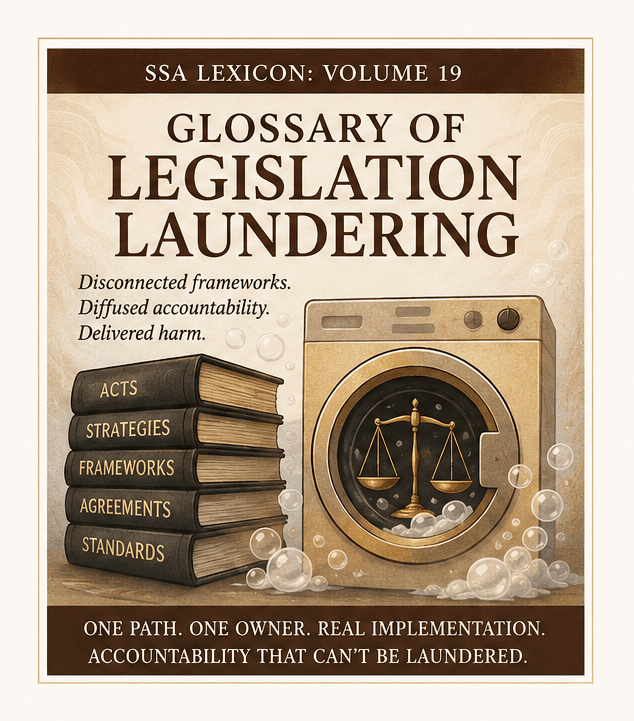
Glossary of Legislation Laundering
This glossary names how disconnected legislation, frameworks, standards, strategies and agreements can obscure accountability, exhaust communities and simulate reform without transferring power or implementation responsibility.